
Walk through any residential street in Lagos, Port Harcourt, Abuja, or Ibadan and you will notice something consistent.
Busy professionals leaving early, returning late, living in apartments with no space or time for domestic chores. Students in rented rooms with no washing machines. Market traders who work six days a week and have no energy left for laundry on the seventh day.
All of those people need someone to wash their clothes. And most of them will pay well for the convenience.
Laundry business profit in Nigeria is one of the most underestimated income opportunities in the country. It is not glamorous. It does not trend on Twitter. Nobody is making YouTube videos about their laundry empire.
But behind that quiet, unglamorous surface is a business with low startup costs, consistent recurring customers, multiple income streams, and profit margins that surprise most people who look at the numbers seriously for the first time.
This guide covers everything. What it actually costs to start a laundry business in Nigeria, how much you can realistically earn, how to price your services correctly, what equipment you need, where to locate your business, and how to grow beyond a single outlet.
Whether you are starting from scratch with minimal capital or you already run a small operation and want to scale, this is the most complete breakdown of the Nigerian laundry business you will find.
Why the Laundry Business Opportunity in Nigeria Is Bigger Than Most People Realize

The demand side of this business is structural. It does not depend on trends, seasons, or economic booms. People generate dirty laundry every single day regardless of what the economy is doing.
In fact, some of the strongest laundry business growth happens during economic pressure periods, when middle-class Nigerians who previously sent clothes to live-in domestic staff switch to neighbourhood laundry services as a more cost-effective alternative.
Nigeria’s urbanization is accelerating. More Nigerians are moving into cities and urban areas every year. Urban dwellers live in smaller spaces, work longer hours, and have less time and less physical space for domestic tasks like laundry.
This urban lifestyle creates a naturally expanding customer base for laundry services without any additional marketing effort from operators.
The competition in most Nigerian neighbourhoods is surprisingly thin. There are traditional hand-wash laundry operators everywhere.
But clean, professional, machine-based laundry services with consistent quality, organized pick-up and delivery, and proper customer communication are still relatively scarce outside the most expensive areas of Lagos and Abuja. That gap is where serious operators build profitable businesses.
Types of Laundry Businesses in Nigeria
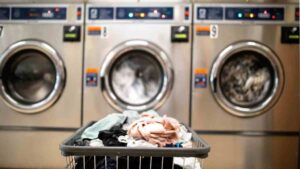
Understanding the different models helps you choose the right entry point for your capital and your target market.
Home-based laundry service
The lowest capital entry point. You operate from your home using washing machines you purchase, take in customer clothes, wash, dry, iron, fold, and return them. You market primarily within your neighbourhood and to contacts through WhatsApp and Instagram.
This model works best in densely populated residential areas where your proximity to customers reduces logistics complexity.
Home-based operations with one washing machine and basic ironing setup can start for N200,000 to N500,000 and generate N80,000 to N250,000 per month once established.
Wash-and-fold neighbourhood laundry shop
A dedicated commercial space in a residential or mixed-use area where customers drop off their clothes. You have machines, ironing stations, and the capacity to handle volume from multiple customers simultaneously.
This is the most common commercial laundry model in Nigerian cities and the one with the most established customer acquisition patterns.
Setup costs range from N500,000 to N3,000,000 depending on shop size, number of machines, and fit-out quality. Monthly revenue potential ranges from N200,000 to N800,000 depending on location and volume.
Dry-cleaning service
Dry cleaning uses chemical solvents rather than water to clean delicate fabrics like suits, gowns, silk, and formal wear. The equipment is more expensive and the chemicals require proper handling. However, dry-cleaning margins are significantly higher than regular laundry.
A single suit dry-cleaned earns N3,000 to N8,000. Formal and corporate neighbourhoods, areas near office districts, and upmarket residential areas are the best markets for dry cleaning.
Dry-cleaning setup costs are higher, starting from N2,000,000 upward for professional equipment. The revenue and margin potential are correspondingly higher.
Laundry pick-up and delivery service (laundry logistics)
A newer model that has grown significantly in Nigerian cities. You do not necessarily need a physical shop that customers visit.
You take orders through WhatsApp, phone calls, or an app, send a rider to pick up dirty clothes from the customer’s home, process the laundry at your facility, and deliver clean, folded clothes back to the customer’s door.
This model serves busy professionals who value convenience above all else and are willing to pay a premium for it. Pricing for pick-up and delivery services is 20% to 40% higher than standard shop pricing because of the convenience premium and the delivery cost.
Commercial and institutional laundry
Hotels, hospitals, schools with boarding facilities, restaurants, event centers, and corporate organizations generate large, consistent volumes of laundry.
Servicing these institutional clients provides steady, predictable revenue that does not depend on retail customer acquisition. However, the equipment requirements for institutional volumes are significantly higher and the pricing negotiation is more complex.
Startup Costs: What You Actually Need to Open a Laundry Business in Nigeria
Let us get specific about money. Here is a realistic cost breakdown for a mid-scale laundry shop.
Washing machines
A good-quality front-load or top-load washing machine suitable for commercial use costs between N150,000 and N450,000 depending on brand, capacity, and where you buy. Brands like LG, Samsung, Hisense, and Polystar are commonly used by Nigerian laundry operators.
For a starting operation, two machines with a combined capacity of 12 to 16 kg per cycle is a practical starting point. Budget N300,000 to N700,000 for machines.
Do not buy the cheapest machines available. Cheap domestic-grade machines used for commercial volumes break down within months. The repair costs and downtime of a broken machine are far more expensive than the premium you would have paid for a better machine upfront.
Tumble dryer
A dryer significantly speeds up your turnaround time and is particularly important during rainy season when air-drying is impractical. A commercial-grade dryer costs N200,000 to N500,000.
Some operators start without a dryer and use outdoor drying with fans, which reduces startup cost but slows turnaround and creates rainy-season problems. If your budget allows, include a dryer from day one.
Industrial irons and ironing boards
Good-quality steam irons for commercial use cost N15,000 to N50,000 each. You need at least two for a properly functioning operation. Ironing boards cost N8,000 to N20,000 each. Budget N60,000 to N150,000 for ironing equipment.
Generator
Power supply is the single biggest operational challenge for laundry businesses in Nigeria. Your machines require stable electricity to run effectively. NEPA supply alone is not reliable enough to run a commercial laundry operation.
A generator with enough capacity to run your machines is essential. For two washing machines and a dryer, you need at minimum a 3.5KVA to 5KVA generator. Cost: N150,000 to N350,000.
Factor fuel costs into your ongoing operating expenses. Generator fuel is a significant cost that many beginners underestimate when planning their numbers.
Shop rent
Location and city determine rental costs enormously. A small shop in a residential area of Lagos or Abuja costs N150,000 to N600,000 per year depending on area. Secondary cities like Enugu, Ibadan, and Kaduna offer significantly lower commercial rents.
Detergents, fabric softeners, and supplies
Monthly consumable costs for a mid-scale operation typically run N15,000 to N40,000 depending on volume. Buying detergents in bulk from wholesale markets (Alaba, Aspamda, Onitsha) reduces per-unit cost significantly.
Shop fitting and signage
Basic shelving, hanging rails, counter space, and outdoor signage cost N30,000 to N150,000 depending on how professionally you want to fit out your space.
Total startup cost estimate:
| Item | Estimated Cost |
|---|---|
| Two washing machines | N300,000 – N700,000 |
| Tumble dryer | N200,000 – N500,000 |
| Irons and boards | N60,000 – N150,000 |
| Generator | N150,000 – N350,000 |
| Shop rent (first year) | N150,000 – N600,000 |
| Shop fitting and signage | N30,000 – N150,000 |
| Initial supplies | N20,000 – N50,000 |
| Miscellaneous and buffer | N50,000 – N100,000 |
| Total | N960,000 – N2,600,000 |
A lean but functional laundry shop can be set up for under N1,500,000 in a mid-density Nigerian residential area. A more fully equipped operation in a prime urban location sits toward the N2,500,000 range.
For home-based operations starting with one machine and no shop rent, startup costs can be as low as N300,000 to N600,000.
Laundry Business Pricing in Nigeria: How to Price Correctly
Pricing is where many Nigerian laundry businesses leave money on the table or price themselves out of the market. Neither extreme works. Here is how to price your services properly.
Standard pricing structure:
Most Nigerian laundry shops price by weight (per kilogram) or by item type. Both models work. Pricing by weight is simpler and more scalable. Pricing by item type is more precise and works better for premium positioning.
Typical market pricing for laundry services in Nigerian cities:
Regular wash, dry, and fold: N800 to N2,000 per kg depending on city and neighbourhood. Lagos Island and Abuja’s Maitama and Wuse charge more than Surulere or Lugbe for the same service.
Ironing only: N200 to N500 per item depending on the garment type.
Duvet and bedding washing: N2,000 to N6,000 per piece depending on size.
Suit dry cleaning: N3,000 to N8,000 per suit.
Traditional attire (Aso-Oke, Agbada, Ankara sets): N2,000 to N5,000 per outfit depending on volume and decoration.
Sneaker and shoe cleaning: N1,500 to N5,000 per pair depending on material and cleaning requirements.
Curtains: N1,500 to N4,000 per curtain panel depending on size.
Pick-up and delivery surcharge: N500 to N2,000 per trip depending on distance.
Express service premium:
Offering a same-day or 24-hour turnaround option at a 30% to 50% premium on standard pricing creates an additional revenue stream from time-sensitive customers. Many working professionals will pay the premium gladly rather than wait two to three days for standard service.
Pricing strategy:
Research what the two or three nearest laundry competitors in your target area are charging. Do not undercut dramatically. Cheap pricing in the laundry business attracts low-quality customers who complain constantly and abandon you the moment a cheaper option appears.
Position yourself at market rate or slightly above it, and compete on quality, reliability, and customer communication rather than on price.
Realistic Laundry Business Profit in Nigeria: The Numbers Breakdown
This is the section most guides skip or gloss over with vague claims. Here is what the numbers actually look like.
Revenue model for a mid-scale laundry shop:
Assume your shop handles 80 kg of laundry per day at an average price of N1,200 per kg (mix of different service types). That is N96,000 in daily revenue.
At five operating days per week (many laundry shops run six or seven), that is N480,000 per week or roughly N1,920,000 per month in gross revenue.
Monthly operating expenses for the same operation:
| Expense | Estimated Monthly Cost |
|---|---|
| Shop rent (annualized monthly) | N25,000 – N50,000 |
| Staff wages (2 washers/ironers) | N80,000 – N140,000 |
| Generator fuel | N40,000 – N80,000 |
| Detergents and supplies | N20,000 – N40,000 |
| Electricity (NEPA top-up) | N10,000 – N20,000 |
| Machine maintenance | N10,000 – N20,000 |
| Rider/delivery costs | N15,000 – N30,000 |
| Marketing and miscellaneous | N10,000 – N20,000 |
| Total expenses | N210,000 – N400,000 |
Net monthly profit:
At N1,920,000 gross revenue and N300,000 average monthly expenses, net monthly profit approaches N1,620,000.
However, reaching 80 kg per day consistently takes time to build. A more realistic trajectory looks like this:
Month one to three: Building your customer base. Revenue of N300,000 to N700,000 per month. Possibly operating at break-even or small profit while covering fixed costs.
Month three to six: Customer base stabilizing with repeat clients. Revenue of N600,000 to N1,200,000 per month. Consistent profit of N200,000 to N600,000 per month.
Month six to twelve: Established operation with loyal customers and word-of-mouth referrals. Revenue of N1,000,000 to N2,000,000 per month depending on volume and pricing. Consistent monthly profit of N500,000 to N1,200,000.
These numbers assume a well-located, professionally run operation in a reasonably populated area. Home-based operations with lower overhead but also lower volume typically generate N100,000 to N400,000 monthly profit once established.
Best Locations for a Laundry Business in Nigeria
Location determines everything in this business. The best laundry shop in a wrong location struggles. A decent shop in the right location fills up quickly.
Target these location characteristics:
Dense residential areas with working professionals. Areas with high concentrations of young working adults, civil servants, bank employees, and tech workers produce the most consistent laundry customers. These people have income, have dirty clothes, and have neither the time nor the inclination to wash themselves.
University campuses and student accommodations. Students are among the most consistent laundry customers in Nigeria. They generate dirty laundry constantly, most live without washing machines, and price sensitivity is manageable if your quality is consistent. A laundry shop near a major Nigerian university can sustain excellent volume year-round.
Areas near office clusters. Proximity to office districts means proximity to the suits, corporate shirts, and formal wear that generate premium dry-cleaning and pressing revenue.
New estate developments. Newly built estates attract relatively affluent buyers and renters who have professional lifestyles and high service expectations. Laundry businesses established early in growing estates build large loyal customer bases before competition arrives.
Avoid these locations:
Areas with very low-income populations who typically hand-wash themselves. Areas with no foot traffic or residential density. Ground-floor locations with no visibility, difficult vehicle access, or no space for customers to drop off and pick up conveniently.
Marketing Your Laundry Business in Nigeria
You can have the best machines, the cleanest results, and the most organized operation in your area and still struggle if nobody knows you exist. Here is how to market effectively.
Flyers and door-to-door introduction
In the first two weeks of opening, cover a one-kilometre radius around your shop with flyers. Include your services, prices, location, phone number, and WhatsApp link. Consider a grand opening discount (first wash 20% off) to trigger trial visits.
Knock on doors in nearby apartment blocks and introduce yourself to property managers and gatemen. Gatemen are an underrated marketing channel. They interact with every resident and can become your informal referral agents if you handle the relationship properly.
WhatsApp Business
Set up your laundry business properly on WhatsApp Business with a complete profile, service catalogue, and automated greeting message. Ask every customer to save your number. Use status posts to remind your contacts of your services, share before-and-after photos, and announce promotions.
Instagram page
An Instagram page with clear before-and-after photos of laundry results, your shop setup, team working, and happy customer testimonials builds credibility for customers who check your social presence before trusting you with their clothes. Clean, bright photography of neatly folded laundry is surprisingly compelling content.
Google My Business
Create a free Google My Business profile for your laundry shop. Include your address, phone number, opening hours, and photos.
This makes your business visible in Google Maps searches. Customers in your area searching for “laundry near me” or “laundry service [your area name]” can find you without you spending on advertising.
Loyalty programs
A simple loyalty card (tenth wash free, or N500 credit after every N10,000 spent) gives regular customers a reason to keep returning to you rather than trying a competitor. Retention is significantly cheaper than acquisition.
Corporate accounts
Approach nearby restaurants, hotels, small offices, and event spaces directly. Offer a corporate rate (slightly discounted but for guaranteed weekly volume) and propose a trial period. One hotel account generating N200,000 per month in laundry revenue is the equivalent of many individual retail customers with far less customer management effort.
Operational Tips That Protect Your Profit and Your Reputation
Tagging and tracking system
Every single item that comes into your shop must be tagged with a unique identifier linked to the customer’s name and order. Lost or mixed-up clothes are the fastest way to destroy a laundry business’s reputation.
Use a simple numbering system with paper tags that go on every item and a logbook or simple spreadsheet that tracks each order from intake to collection.
Condition recording at intake
Before washing any item, note and ideally photograph any existing damage, stains, or defects. Inform the customer of these at drop-off. This protects you against claims that your washing damaged items that were already damaged when they arrived.
Turnaround time commitment
Tell every customer exactly when their clothes will be ready and honour that commitment. Nothing frustrates Nigerian customers more than coming to collect clothes that are not ready. Under-promise and over-deliver. If you can have it done in one day, tell the customer two days and surprise them with early completion.
Handling delicate items
Not everything can go in the machine at the same temperature. Sorting by fabric type, colour, and temperature requirement before washing is basic professional practice that prevents damage and the expensive complaints that follow. Train every member of your team on basic sorting and fabric care.
Frequently Asked Questions About Laundry Business Profit in Nigeria
How profitable is a laundry business in Nigeria?
A well-located, professionally run laundry shop in a Nigerian city can generate net monthly profit of N300,000 to N1,200,000 once fully established, depending on scale, pricing, and location. Home-based operations typically generate N100,000 to N400,000 monthly profit.
The business has strong recurring revenue characteristics because satisfied customers return weekly or fortnightly.
How much does it cost to start a small laundry business in Nigeria?
A home-based laundry operation can start for N300,000 to N600,000. A mid-scale shop with two machines, a dryer, and basic fit-out in a rental space typically costs N960,000 to N2,600,000 depending on location and equipment quality.
Which is more profitable: regular laundry or dry cleaning?
Dry cleaning generates higher revenue per item and higher margins per transaction. A single suit dry-cleaned at N5,000 earns more than five kilograms of regular laundry at N1,000 per kg.
However, dry cleaning requires significantly higher startup costs and more specialist knowledge. A combined laundry and dry-cleaning operation captures both markets.
Do I need any certification or license to run a laundry business in Nigeria?
At the small business level, formal certification is not a strict requirement to operate. You should register your business name with the CAC, obtain any applicable local government business permit for your area, and comply with environmental regulations regarding wastewater disposal. For dry-cleaning operations using chemical solvents, compliance with relevant environmental standards is important.
How do I prevent clothes from getting lost or mixed up?
A proper tagging system is non-negotiable. Every item that enters your shop gets a unique numbered tag tied directly to a customer intake record. Maintain a logbook or simple spreadsheet with customer name, contact number, items received, and date promised. Before returning any order, check every item against the intake record.
Can I run a laundry business alongside a full-time job?
Yes, particularly in the early stages with a home-based model or with hired staff managing day-to-day operations.
Many Nigerian laundry businesses are started by owners who hire one or two operators to run the shop while they maintain their employment. As the business grows and income becomes more significant, transitioning to full-time ownership becomes a natural decision.
Final Thoughts
The laundry business in Nigeria is exactly the kind of business that serious, patient entrepreneurs build real wealth from. It is not viral.
It is not exciting to talk about. But it solves a daily, permanent problem for millions of Nigerians and generates recurring, predictable income month after month from a loyal customer base that comes back as long as you do the job well.
The profit is real. The demand is consistent. The barriers to entry are lower than almost any other service business of comparable income potential. And unlike trend-dependent businesses that boom and fade, nobody is ever going to stop generating dirty clothes.
What makes the difference is not the equipment or the location alone. It is the consistency of quality, the reliability of turnaround times, the professionalism of customer communication, and the patience to build a loyal base before scaling.
Start with the capital you have. Pick the right location. Do excellent work on every single order. Ask happy customers to refer their neighbours. Reinvest your early profits into better equipment and eventually additional locations.
The business builds on itself. Clean clothes, clean reputation, clean profit.
Disclaimer
This article is written for informational and educational purposes only. All financial figures, startup costs, and profit estimates mentioned are illustrative and based on general market observations.
Actual results will vary significantly based on location, capital deployed, operational quality, pricing, competition, and individual business execution. Starting any business involves financial risk including the possible loss of invested capital.
The author and publisher of this content accept no liability for any financial loss or business outcome arising from reliance on information provided in this article.
Always conduct independent research and consult qualified business and financial advisors before making any investment or business decision.
What to Consider Before You Start
Choose an option based on your available money, skills, time, location, and ability to find customers or clients. Income examples are not guarantees. Start with a manageable test, track your actual costs and results, and adjust your plan based on evidence.
Practical First Steps
Write down the resources you already have, what you still need, and the first customer or client you want to reach. Separate one-time startup costs from recurring expenses. This makes it easier to see whether the idea is affordable and sustainable.
Risks and Warning Signs
Be careful with opportunities that require unexplained upfront payments, promise guaranteed earnings, or pressure you to act immediately. Verify platforms and important claims before providing personal information or sending money.
How to Measure Whether It Is Working
Track revenue, expenses, time spent, customer response, and repeat business. A simple record of these figures can help you decide whether to continue, change your approach, or stop before losses become larger.
Related MoneyX Guides
Continue with these related guides for practical information that can help you make a better-informed decision:
- How to Start Affiliate Marketing in Nigeria: A Practical Beginner's Guide
- 25 Profitable Business Ideas in Nigeria: Startup Costs, Demand and How to Choose
- 20 Businesses to Start With ₦500,000 in Nigeria: Costs, Profit Potential and Risks
- 18 Businesses to Start With ₦200,000 in Nigeria: Practical Startup Guide




Comments 0
No comments yet
Be the first to share your thoughts.
Leave a Comment
Your email will not be published.