
Nigeria has over 13 million registered vehicles on its roads. That number grows every year as more Nigerians acquire cars, ride-hailing drivers join platforms, and logistics fleets expand across cities. Every single one of those vehicles gets dirty.
Every single one needs washing. And the vast majority of Nigerian car owners would rather pay someone else to do it than spend their Saturday morning crouching beside a bucket.
Car wash business profit in Nigeria is a topic that deserves more serious attention than it typically gets.
Most people write it off as a small roadside hustle. But look more carefully at a well-located, professionally run car wash in Lagos, Abuja, Port Harcourt, or Enugu and you will find a business generating N300,000 to N800,000 in monthly revenue with relatively low operating costs and a customer base that comes back every one to two weeks like clockwork.
This guide breaks down the real numbers. What it costs to start, what you can realistically charge, what your monthly profit looks like at different scales, where to locate your business, how to market it, and how to grow beyond a single bay operation.
Whether you are starting from scratch or evaluating the car wash business as a serious investment, everything you need to make an informed decision is here.
Why the Car Wash Business Makes Sense in Nigeria Right Now
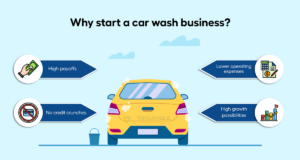
The demand fundamentals for car washing in Nigeria are strong and they are not going anywhere.
Vehicle ownership in Nigeria is growing steadily. As the urban middle class expands, car ownership rises with it. More cars in a city means more potential customers within a short drive of any given car wash location.
Nigerian roads are notoriously dusty and muddy depending on season. The harmattan season coats vehicles in fine red dust within hours of washing. Rainy season covers cars in mud and road splash every few days.
Unlike temperate climates where a car might stay clean for a week after washing, Nigerian conditions mean vehicles need washing far more frequently. This shortens the repurchase cycle and increases the number of visits a single customer makes per month.
Urban Nigerians increasingly outsource domestic tasks. The car wash business benefits directly from the same trend that fuels laundry services, food delivery, and cleaning services. Time-poor, income-earning urban Nigerians pay for convenience. Car washing is a perfect fit for this lifestyle pattern.
Ride-hailing drivers are a specific and highly valuable customer segment. Drivers on Bolt, inDrive, and similar platforms need clean cars to maintain ratings and attract passengers.
Many wash their vehicles daily or every other day. A single ride-hailing driver represents five to fifteen car wash visits per month, every single month, as long as they are on the platform.
Types of Car Wash Businesses in Nigeria
Before getting into numbers, understand which model you are building. Each has different startup costs, revenue potential, and operational requirements.
Manual hand wash
The most common and accessible model. Workers wash vehicles by hand using buckets, hoses, sponges, and cleaning chemicals. No expensive machinery required. Labour is the primary input cost.
Manual washes are the dominant format across most Nigerian cities outside premium areas. They are affordable to start and the service quality can be excellent with properly trained staff. The limitation is throughput. A manual wash takes 20 to 40 minutes per vehicle and requires at least two workers per bay to maintain speed.
Semi-automatic wash
Uses a pressure washer for the initial rinse and wheel cleaning, then manual washing for the bodywork, interior vacuuming, and finishing. The pressure washer significantly speeds up the wash process and improves the quality of undercarriage cleaning. This is the sweet spot for operators who want better output without the full investment of automated equipment.
Full-service detailing centre
Beyond the basic wash, full detailing services include interior deep cleaning, engine bay washing, paint polishing, waxing, seat shampooing, and ceramic coating. Detailing commands significantly higher prices per vehicle and attracts car enthusiasts and owners of premium vehicles who invest in their cars. A full detail job on an SUV can earn N30,000 to N100,000 or more depending on the service depth.
Mobile car wash
You go to the customer rather than them coming to you. Using a mobile pressure washer, portable water tank, and cleaning kit loaded in a vehicle, you wash cars at homes, offices, and estates. Low fixed overhead since there is no shop rent.
Marketing is through WhatsApp, Instagram, and direct contact with estate managers. This model works particularly well in high-end residential estates where residents value the convenience of doorstep service.
Startup Costs: What You Need to Open a Car Wash in Nigeria
Here is a realistic cost breakdown for a standard semi-automatic hand wash operation in a Nigerian city.
Land or space
This is your single biggest startup cost decision. You need a space large enough to accommodate at least two vehicles simultaneously being washed plus a waiting area and drainage. Space options include:
Renting a plot or commercial space specifically for the car wash. Monthly rental for a suitable roadside commercial plot in a mid-density Nigerian urban area ranges from N30,000 to N150,000 per month depending on city and location quality.
Partnering with an existing business that has underutilized space in a high-traffic area. Fuel stations, shopping complexes, and large compound owners sometimes lease car wash operating rights to operators at a fixed monthly fee or revenue share arrangement.
Pressure washer
An industrial-grade pressure washer suitable for commercial use costs N80,000 to N250,000 depending on brand, pressure rating (PSI), and water flow rate. Brands like Karcher, Black+Decker, and Chinese-manufactured alternatives are commonly used by Nigerian operators. Do not buy a domestic-grade pressure washer for commercial use. It will burn out within weeks under daily commercial load.
Water storage and supply
Consistent water supply is critical. Most car wash operations combine borehole water, overhead tank storage, and sometimes municipal supply.
A functional borehole installation including drilling, casing, pump, and overhead tank costs N300,000 to N700,000 depending on depth and equipment quality. Buying water from tankers is a more expensive ongoing cost but avoids the upfront borehole investment.
Budget N300,000 to N700,000 for water infrastructure if drilling a borehole.
Generator
Powering your pressure washer, vacuum cleaner, lighting, and music system requires a reliable generator given Nigeria’s irregular power supply. A 3.5KVA to 5KVA generator costs N150,000 to N300,000.
Vacuum cleaner
A wet and dry industrial vacuum cleaner for interior vacuuming and seat cleaning costs N30,000 to N80,000.
Basic tools and consumables
Buckets, sponges, microfibre towels, wash mitts, tyre brushes, and initial stock of car wash chemicals, shampoo, tyre shine, glass cleaner, and interior dressing. Initial stock costs N30,000 to N60,000.
Shade structure and waiting area
A basic shade canopy over the wash bay area and simple seating for waiting customers costs N50,000 to N150,000 depending on materials and size.
Signage
Clear, professional signage attracting attention from passing traffic is a worthwhile investment. Budget N20,000 to N60,000 for quality outdoor signage.
Total startup cost estimate:
| Item | Estimated Cost |
|---|---|
| Space rental (first 3 months) | N90,000 – N450,000 |
| Pressure washer | N80,000 – N250,000 |
| Borehole and water system | N300,000 – N700,000 |
| Generator | N150,000 – N300,000 |
| Vacuum cleaner | N30,000 – N80,000 |
| Tools and initial consumables | N30,000 – N60,000 |
| Shade structure and waiting area | N50,000 – N150,000 |
| Signage | N20,000 – N60,000 |
| Miscellaneous and contingency | N30,000 – N80,000 |
| Total | N780,000 – N2,130,000 |
A lean but functional car wash operation can be started for under N1,000,000 in a secondary Nigerian city or in areas with lower land costs. Prime urban locations in Lagos or Abuja push the startup cost toward the upper range.
For a mobile car wash model with no fixed location, startup costs drop dramatically to N200,000 to N500,000 covering the pressure washer, portable water system, chemicals, and a vehicle to operate from.
Car Wash Pricing in Nigeria: What to Charge
Pricing varies significantly by city, neighbourhood quality, and service type. Here are realistic market ranges.
Standard exterior wash (saloon cars): N1,500 to N3,500
Standard exterior wash (SUVs and trucks): N2,500 to N5,000
Full wash and vacuum interior (saloon cars): N3,000 to N6,000
Full wash and vacuum interior (SUVs): N5,000 to N9,000
Engine wash: N3,000 to N8,000
Full detailing (saloon cars): N15,000 to N40,000
Full detailing (SUVs and luxury vehicles): N30,000 to N100,000+
Waxing and polishing: N10,000 to N35,000 depending on vehicle size
Seat and upholstery shampooing: N5,000 to N15,000
Monthly subscription packages: N15,000 to N35,000 per month for daily wash customers
Premium locations in Abuja’s Maitama or Lagos Island command prices at the top of these ranges. Mainland Lagos, Port Harcourt, Ibadan, and secondary cities fall in the mid-range. Outskirts and lower-income areas price at the lower end.
Pricing strategy:
Research the three nearest competitors in your target location before setting your prices. Position at the mid to upper end of local market rates if your service quality, presentation, and location justify it. Competing on price alone attracts customers who will leave for the next N200 cheaper option. Competing on quality, speed, and customer experience builds loyalty.
Car Wash Business Profit in Nigeria: Real Numbers Breakdown

This is the section that matters most for anyone making a serious business decision. Here is what the numbers actually look like.
Revenue model for a standard car wash operation:
Assume your car wash handles 25 vehicles per day on weekdays and 40 vehicles on weekends. Average revenue per vehicle across your service mix is N3,500.
Weekday revenue: 25 vehicles x N3,500 = N87,500 per day Weekend daily revenue: 40 vehicles x N3,500 = N140,000 per day
Monthly revenue (22 weekdays + 8 weekend days): Weekdays: 22 x N87,500 = N1,925,000 Weekends: 8 x N140,000 = N1,120,000 Gross monthly revenue: N3,045,000
Monthly operating expenses:
| Expense | Estimated Monthly Cost |
|---|---|
| Space rent | N50,000 – N150,000 |
| Staff wages (3 to 4 workers) | N120,000 – N200,000 |
| Generator fuel | N60,000 – N120,000 |
| Water (if buying from tankers) | N40,000 – N80,000 |
| Chemicals and consumables | N30,000 – N60,000 |
| Equipment maintenance | N15,000 – N30,000 |
| Electricity | N10,000 – N20,000 |
| Marketing | N10,000 – N20,000 |
| Miscellaneous | N15,000 – N30,000 |
| Total expenses | N350,000 – N710,000 |
Net monthly profit:
At N3,045,000 gross revenue and N530,000 average monthly expenses, net monthly profit approaches N2,515,000.
However, 25 vehicles per weekday requires a well-located, established operation with regular customers. A more conservative trajectory for a newer business:
Realistic phased profit timeline:
Months one to three (building customer base): 10 to 15 vehicles per day. Revenue N800,000 to N1,200,000 per month. After expenses, net profit of N200,000 to N500,000 per month.
Months three to six (gaining regular customers): 15 to 20 vehicles per day. Revenue N1,200,000 to N1,800,000 per month. Net profit of N500,000 to N900,000 per month.
Month six to twelve (established operation): 20 to 30 vehicles per day. Revenue N1,800,000 to N2,500,000+ per month. Net profit of N900,000 to N1,500,000 per month.
Beyond year one with strong location and loyal customer base: N1,500,000 to N2,500,000 net monthly profit is achievable for well-run operations in high-traffic areas.
These projections assume good location, consistent quality, and active customer retention. Poor location or inconsistent service quality will produce significantly lower results.
Best Locations for a Car Wash Business in Nigeria
Location determines the ceiling of what your car wash can earn more than any other single factor. Here is exactly what to look for.
High vehicle traffic corridors
Roads with heavy daily vehicle movement, particularly routes where cars slow down or stop, give your signage maximum visibility and make it easy for drivers to pull in spontaneously. Expressway service roads, major arterial roads in residential areas, and roads leading to estate gates are strong candidates.
Near fuel stations
Vehicles that stop for fuel are already primed for a car wash. A car wash located adjacent to or very close to a fuel station captures customers who are already in maintenance mode. Some operators enter formal arrangements with fuel station owners for co-located operations.
Residential estate entrances and surroundings
Middle and upper-middle-class residential estates generate concentrated vehicle ownership in a small geographic area. A car wash near the gate of a large estate with 500 to 2,000 housing units has a captive local customer base within walking or short driving distance.
Near offices and commercial hubs
Office district car washes serve employees who drop their car for washing during work hours and collect it clean when they finish. This model requires fast turnaround (under 30 minutes for a basic wash) but generates consistent weekday volume from professional customers.
University areas
Students with cars, lecturers and university staff, and the general traffic generated by a large university community create strong car wash demand near campuses.
Avoid these locations:
Areas with very low vehicle density. Locations with no clear access or visibility from the road. Areas with drainage problems that make the wash area perpetually flooded. Locations where landlords impose restrictive lease terms that can displace your business after you have invested in setup.
How to Market Your Car Wash Business in Nigeria
Professional signage
Your first and most constant advertisement is your signage. Bright, clear, professionally designed signage visible from the road should list your services and prices at minimum. Many drivers make the decision to pull in based solely on what they read from a moving car. Bad signage loses customers you never even meet.
WhatsApp Business
Set up WhatsApp Business and collect every customer’s number. Send periodic broadcasts with special offers, monthly subscription deals, and reminders. A simple message: “Weekend special: full wash and interior vacuum for N4,500 this Saturday and Sunday only” drives bookings on days that would otherwise be slow.
Monthly subscription packages
Offering monthly unlimited or fixed-frequency wash packages at a discounted rate creates predictable recurring revenue and locks customers in. A customer who pays N20,000 for a month of twice-weekly washes is committing to eight visits before the month ends. They will bring their car even when they might otherwise have skipped because the payment is already made.
Ride-hailing driver partnerships
Reach out to Bolt and inDrive driver communities through their Facebook groups and WhatsApp communities. Offer a dedicated ride-hailing driver rate (slightly discounted) in exchange for daily or near-daily business. Ten ride-hailing driver regulars alone can anchor your weekday volume.
Corporate fleet accounts
Companies with vehicle fleets, NGOs, logistics businesses, and government contractors need regular washing for their vehicles. Approach fleet managers directly with a corporate rate proposal. A single corporate account with ten vehicles generating two washes per month at N4,000 per vehicle adds N80,000 per month in committed revenue.
Google My Business
Create a Google My Business listing with your address, phone number, photos, and opening hours. Nigerians increasingly search “car wash near me” on Google. Being visible in those results costs nothing and drives genuinely interested local customers.
Before-and-after photos of washed vehicles, videos of your team at work, and customer testimonials make compelling Instagram content. A consistent page builds credibility and generates DM inquiries from customers who found you through search or explore.
Operational Excellence: What Separates Profitable Car Washes from Struggling Ones
Consistent quality every time
A customer whose car comes out dirty in one spot, scratched on the panel, or with chemical residue on the trim will not return. Train your staff meticulously on proper washing technique, safe handling of painted surfaces, and a quality check process before handing back every vehicle.
Speed without sacrificing quality
Customers waiting more than 45 minutes for a basic wash become impatient and complain. Optimize your wash process to consistently deliver a standard exterior wash in 25 to 35 minutes. Time your service and identify bottlenecks in your workflow.
Customer data and follow-up
Record every customer’s name, number, and vehicle details. Follow up with customers who have not returned in three or four weeks. A simple message: “We have not seen your car in a while. Come in this week for a complimentary tyre shine with your wash” costs nothing and re-activates dormant customers regularly.
Keep the environment clean
A muddy, disorganized, water-logged car wash area gives customers the impression that their car will be no cleaner than the environment it is being washed in. Invest in proper drainage, keep your wash area clean, and maintain a waiting space that people actually want to sit in.
A small investment in ambience (clean seating, a TV, cold water for waiting customers) creates a noticeably better experience than competitors who overlook it.
Hire and retain good staff
Your staff directly determine the quality of every single wash. Pay fair wages, train consistently, and recognize good performance. High staff turnover in a car wash business disrupts quality and forces constant retraining. A stable, well-trained team is worth more than any piece of equipment you can buy.
Frequently Asked Questions About Car Wash Business Profit in Nigeria
How profitable is a car wash business in Nigeria?
A well-located, professionally run car wash in a Nigerian city generates net monthly profit of N500,000 to N2,500,000 depending on vehicle volume, service mix, and operating efficiency. Newer operations in the first three to six months typically earn N200,000 to N600,000 net monthly as they build their customer base.
How much does it cost to start a car wash in Nigeria?
A functional car wash operation costs between N780,000 and N2,130,000 to set up depending on location, equipment choices, and whether you drill a borehole or buy water. A mobile car wash model can start for N200,000 to N500,000 with significantly lower fixed costs.
Do I need to hire staff or can I run it alone?
Running a car wash alone limits your throughput to roughly five to eight vehicles per day, which is insufficient for a commercially viable operation. Most successful car wash businesses employ two to four workers per shift. Staff wages are a significant operating cost but essential for volume.
Is a car wash business affected by rainy season in Nigeria?
Rainy season actually increases car washing frequency in many areas because vehicles get mud-splashed more often.
The main operational challenge during rain is keeping the wash area functional with proper drainage. A covered wash bay significantly reduces rain-related disruption. Overall, seasonal variation is less extreme in car washing than in many other businesses.
Can I run a car wash business without a borehole?
Yes, but buying water from tankers is significantly more expensive per litre than borehole water and creates supply uncertainty. Many operators start with tanker water to avoid the upfront borehole cost and transition to borehole water once cash flow supports the investment. If your landlord has borehole access, a water-sharing arrangement may be negotiable.
How do I handle customers who claim my staff scratched their vehicle?
Before washing any vehicle, walk around it with the customer or your staff and note existing scratches, dents, and paint chips on a simple intake form that both parties acknowledge. This protects you against claims of damage that existed before the wash.
For genuine damage caused by your staff, handle it professionally and promptly. The cost of one repair handled graciously is far less than the cost of a customer who tells everyone their story of poor treatment.
Final Thoughts
The car wash business in Nigeria is a genuine opportunity hiding in plain sight. It is physical, operational, and unglamorous in a way that deters people who want easy digital income. But that same unglamorous quality is what keeps competition manageable and what keeps the business running reliably when digital trends come and go.
Nigeria’s roads are dusty, its car ownership is growing, and its urban professionals increasingly outsource tasks they used to do themselves. All three of those realities benefit the car wash business directly and none of them are changing any time soon.
The profit is real and it is significant for operators who choose the right location, maintain consistent quality, build a loyal customer base, and run the operation with the discipline it deserves. Start with realistic expectations about the customer build-up period, invest properly in your setup, and give your business six to twelve months to reach its earning potential.
The cars will keep coming. Your job is to make sure they keep coming back to you.
Disclaimer: This article is written for informational and educational purposes only. All financial figures, startup costs, revenue projections, and profit estimates mentioned are illustrative and based on general market observations.
Actual results will vary significantly depending on location, competition, operational quality, pricing, management skill, and prevailing economic conditions. Starting any business involves financial risk including the possible loss of invested capital.
The author and publisher of this content accept no liability for any financial loss or business outcome arising from reliance on information provided in this article. Always conduct independent research and consult qualified business and financial advisors before making any investment or business decision.
What to Consider Before You Start
Choose an option based on your available money, skills, time, location, and ability to find customers or clients. Income examples are not guarantees. Start with a manageable test, track your actual costs and results, and adjust your plan based on evidence.
Practical First Steps
Write down the resources you already have, what you still need, and the first customer or client you want to reach. Separate one-time startup costs from recurring expenses. This makes it easier to see whether the idea is affordable and sustainable.
Risks and Warning Signs
Be careful with opportunities that require unexplained upfront payments, promise guaranteed earnings, or pressure you to act immediately. Verify platforms and important claims before providing personal information or sending money.
How to Measure Whether It Is Working
Track revenue, expenses, time spent, customer response, and repeat business. A simple record of these figures can help you decide whether to continue, change your approach, or stop before losses become larger.
Related MoneyX Guides
Continue with these related guides for practical information that can help you make a better-informed decision:
- How to Start Affiliate Marketing in Nigeria: A Practical Beginner's Guide
- 25 Profitable Business Ideas in Nigeria: Startup Costs, Demand and How to Choose
- 20 Businesses to Start With ₦500,000 in Nigeria: Costs, Profit Potential and Risks
- 18 Businesses to Start With ₦200,000 in Nigeria: Practical Startup Guide




Comments 0
No comments yet
Be the first to share your thoughts.
Leave a Comment
Your email will not be published.