 MM Kolawole
Table of Contents Show
If you have been looking for a reliable platform to track POS terminal data, agent networks, and provider market share across Africa, then POSmarketCap is probably the most exciting thing to happen to African fintech intelligence in recent years.
This platform is built specifically for people who want real, live data on the POS ecosystem in Nigeria, Ghana, and Kenya.
Whether you are a business owner, a fintech investor, a researcher, or just someone who is genuinely curious about how Africa’s payment infrastructure is growing, POSmarketCap gives you a front-row seat to all of it.
In this review, we are going to take a deep look at what POSmarketCap is, what it does, who it is for, and why so many people in Africa’s fintech space are paying close attention to it.
We will also talk about the state of the POS market itself, because understanding the context makes you appreciate the tool so much more.
What Is POSmarketCap?
POSmarketCap is an online intelligence platform that tracks Point of Sale (POS) infrastructure across Africa.
Think of it like a stock market tracker, but instead of tracking company shares, it tracks POS terminals, agent counts, provider rankings, and transaction data.
The platform currently covers three major African markets: Nigeria, Ghana, and Kenya.
These are three of the most active fintech markets on the continent, and together they represent a massive portion of Africa’s digital payment activity.
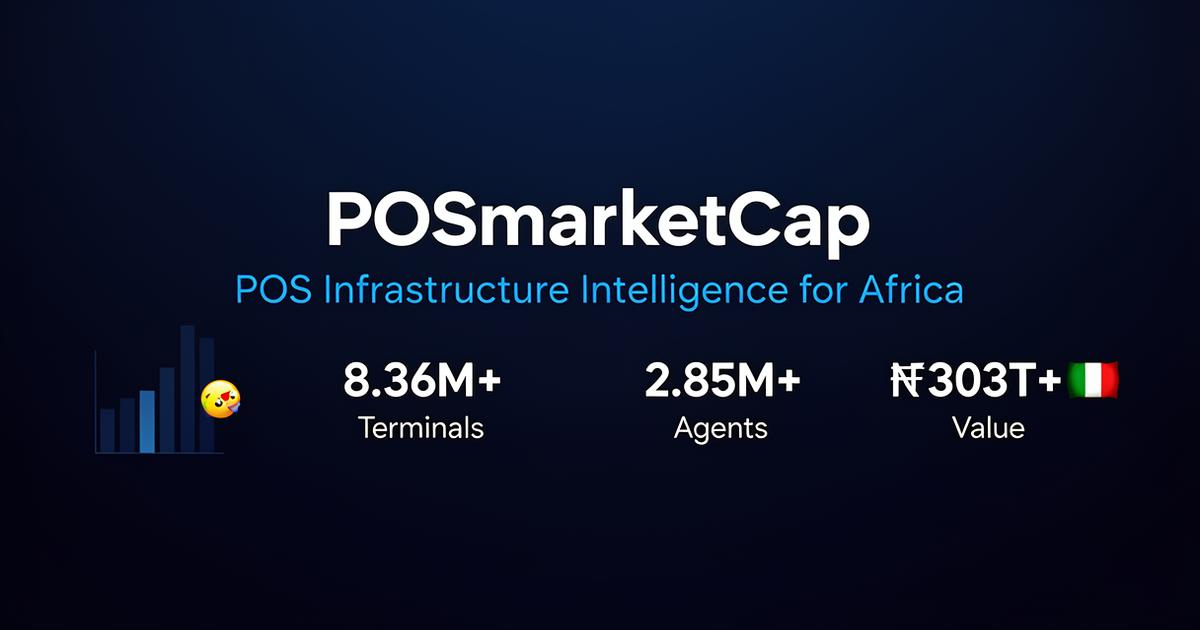
At the time of writing, POSmarketCap has live data on over 8.36 million terminals and more than 2.85 million agents. Those numbers alone tell you just how large and important Africa’s POS network has become.
The platform allows you to compare POS providers head to head. For example, you can pull up a Moniepoint vs OPay comparison and see exactly how each provider stacks up in terms of market share, agent count, and coverage. That kind of transparency was simply not available before POSmarketCap came along.
Why Africa’s POS Market Is Such a Big Deal
To understand why a platform like POSmarketCap matters, you first need to appreciate how dramatically POS infrastructure has reshaped everyday life in Africa, especially in Nigeria.
Nigeria’s POS story is honestly one of the most remarkable transformations in any financial market globally. Just a few years ago, Nigerians relied almost entirely on bank branches and ATMs to access their money. That has completely changed.
By March 2025, Nigeria had 5.90 million active POS terminals processing transactions worth nearly 5 billion naira every single hour.
Meanwhile, the number of active ATMs had actually fallen to around 16,714 machines. Nigeria now has one POS terminal for every 26 citizens. That is a complete reversal of the traditional banking model, and it happened fast.
POS transactions surged from 2.62 trillion naira in the first quarter of 2024 to 10.51 trillion naira in the first quarter of 2025.
That is a 301% year-on-year growth rate. For the full year 2024, POS terminals processed 18 trillion naira across 1.5 billion transactions, up 69% from the year before.
These numbers are staggering. And POSmarketCap exists precisely to make sense of all of this activity.
Who Uses POSmarketCap?
POSmarketCap is useful for a wide range of people. Here is a breakdown of who benefits the most from using it.
Fintech Companies and POS Providers
If you run or work at a fintech company that deploys POS terminals, this platform is a goldmine. You can monitor your own market share, track your competitors, and identify regions where coverage is still thin. Instead of guessing, you are working with real data.
Investors and Venture Capitalists
Africa’s fintech space attracts serious international investment. Companies like Moniepoint, OPay, and PalmPay have collectively raised hundreds of millions of dollars. Investors who want to understand the real competitive landscape before making a bet on a company can use POSmarketCap to see who is actually winning on the ground.
Researchers and Analysts
Financial inclusion researchers, policy analysts, and academics studying Africa’s payment ecosystem will find POSmarketCap extremely useful. The platform aggregates data that would otherwise require expensive surveys or slow government reports to access.
Journalists and Media Professionals
Anyone covering African fintech for a publication needs accurate, current data. POSmarketCap provides that in a clean, easy-to-read format, saving journalists the hours they would otherwise spend digging through company press releases and central bank reports.
Business Owners and Merchants
If you are a business owner thinking about which POS provider to sign up with, POSmarketCap helps you see which providers have the most agents in your area, who has better coverage, and who is growing fastest. That is information you can use to make a smarter decision.
Key Features of POSmarketCap
Let’s talk specifically about what the platform offers. Based on what is publicly available, here are the standout features.
Real-Time Terminal and Agent Data
This is the core of the platform. POSmarketCap pulls and displays live data on terminal deployments and agent counts across Nigeria, Ghana, and Kenya. When a provider adds new terminals or grows its agent network, you see it reflected in real time.
This is huge because the POS market moves fast. Moniepoint, for example, went from around 303,000 agents in 2022 to deploying over one million terminals by 2025. Tracking that kind of growth on a platform like POSmarketCap gives you a clear picture of momentum.
Provider Comparison Tool
One of the most talked-about features is the ability to compare providers directly. You can go to the platform and run a comparison between, say, Moniepoint and OPay, and see side-by-side data on agent counts, terminal numbers, and market share.
This kind of competitive intelligence used to require you to work at a top consulting firm or have connections inside the companies themselves. POSmarketCap democratizes that information.
Market Share Tracking
The platform tracks market share across providers, which is genuinely useful for understanding the balance of power in the ecosystem. Nigeria’s POS market, for example, is dominated by a small number of players. Moniepoint currently processes roughly 42% of Nigeria’s total POS transaction volumes. OPay has historically held around 25% of the market. PalmPay accounts for about 18%. Together these three players control around 85% of Nigeria’s agent banking ecosystem. Seeing those numbers laid out visually makes a huge difference.
Multi-Country Coverage
Unlike most Nigerian fintech data sources that focus entirely on Nigeria, POSmarketCap covers Ghana and Kenya as well. This gives it regional relevance and makes it a useful tool for organizations operating across multiple African markets.
Clean, Easy-to-Read Interface
One thing users appreciate about POSmarketCap is that the data is presented clearly. You do not need to be a data analyst to understand what you are looking at. The dashboards and comparison tools are designed to be accessible, which makes the platform useful for a broad audience.
POSmarketCap in the Context of Africa’s Fintech Revolution

To truly appreciate what POSmarketCap is doing, it helps to understand the fintech revolution it is built around.
Africa’s POS agents are often described as the continent’s “last mile” financial infrastructure. In communities where banks have no branches and ATMs are scarce, a local shop owner with a POS machine becomes the entire banking system for that neighborhood.
People use POS agents to deposit cash, withdraw money, pay bills, receive transfers, and access credit.
This is not a small, niche service. In Nigeria, 36% of adults used a POS agent for deposits or withdrawals in 2023. That is tens of millions of people. In rural areas, POS devices sometimes represent the only interface between people and the formal financial system at all.
The companies building these networks, Moniepoint, OPay, PalmPay, FirstBank through Firstmonie, and others, are not just payment companies. They are becoming financial infrastructure in the truest sense of the word.
Moniepoint is a clear example of this. It has grown its card user base by 200% in recent years, with its cards used 1.7 million times daily.
It disbursed over 1 trillion naira in business loans in 2025, with loan recipients seeing an average 36% increase in their transaction values after receiving credit. Eight out of ten in-person payments in Nigeria are reportedly made with Moniepoint.
OPay, backed by significant Chinese investment totaling $570 million, built a massive agent network quickly by focusing on a consumer-first strategy.
PalmPay, backed by Transsion Holdings, the company behind popular phone brands like TECNO and Infinix, leveraged smartphone distribution channels to grow its user base rapidly.
POSmarketCap sits at the center of all this activity, making the data legible and actionable for anyone who needs it.
Why POSmarketCap Gets Positive Reviews
People who use POSmarketCap tend to be genuinely impressed with what it delivers. Here is a summary of the reasons behind the positive reception.
It Fills a Real Gap
Before POSmarketCap, getting accurate, current data on Africa’s POS infrastructure was genuinely hard. You had to piece together information from central bank reports, company announcements, and third-party surveys.
The data was often months old by the time it was published. POSmarketCap changes that by providing live information. Users consistently praise the platform for solving a problem they had been dealing with for years.
The Scale of Data Is Impressive
Tracking 8.36 million terminals and 2.85 million agents across three countries is not a small engineering feat.
Users note that the sheer volume and granularity of the data available on the platform is far beyond what they expected. For researchers and analysts in particular, this depth of data is a significant value-add.
It Makes Complex Markets Understandable
Africa’s POS market is complicated. You have multiple providers, different regulatory environments in different countries, rapidly shifting market shares, and a constantly growing total network.
POSmarketCap takes all of that complexity and presents it in a format that is genuinely easy to navigate. That accessibility is something users repeatedly highlight.
It Is Useful Across Multiple Use Cases
What makes POSmarketCap particularly strong is that it is not built for just one type of user. Investors, operators, researchers, journalists, and merchants all find value in it. A platform that serves that many different audiences well is rare, and users appreciate the versatility.
It Reflects the Reality on the Ground
One criticism of fintech data platforms in Africa is that they often reflect what companies claim rather than what is actually happening.
POSmarketCap’s live data approach means it is tracking real terminal deployments and real agent activity, not press release numbers. That authenticity resonates with users who have been burned by inaccurate data in the past.
The Bigger Picture: Why Africa Needed POSmarketCap
There is a broader reason why a platform like POSmarketCap is not just useful but actually necessary.
Africa’s financial sector is transforming faster than any other region’s. Mobile POS adoption is rising sharply, with over 40% of retail transactions in some markets now processed through mobile payment apps and mPOS devices.
Governments are pushing cashless payment initiatives. Regulators are introducing new rules, like Nigeria’s Central Bank mandating that POS agents align exclusively with a single provider by April 2026, which reshaped the competitive landscape overnight.
In an environment where things change this fast, having a reliable, real-time intelligence platform is not a luxury. It is a necessity. Businesses cannot afford to make major decisions based on data that is six months old when the market is shifting month by month.
POSmarketCap is providing the infrastructure for smarter decision-making across Africa’s payment ecosystem. That is a genuinely valuable contribution to the continent’s financial development.
What Sets POSmarketCap Apart From Other Data Platforms
There are other fintech data platforms that cover Africa, so it is worth asking: what makes POSmarketCap different?
The answer is specificity. Most data platforms that cover African fintech are generalist in nature. They might include a section on payments alongside sections on lending, insurance, and crypto.
POSmarketCap goes deep on one specific area: POS infrastructure. That depth of focus means the data is richer and more detailed than what you get from a generalist platform.
The provider comparison feature is also relatively unique. Being able to run a side-by-side comparison of Moniepoint and OPay on real terminal and agent data is not something you can easily do anywhere else. That specificity is a major competitive advantage.
The real-time nature of the data is another differentiator. Traditional market research reports are published quarterly or annually.
By the time you read them, the market has moved on. POSmarketCap’s live data approach keeps users current in a way that static reports simply cannot.
Challenges and Room to Grow
No honest review is complete without acknowledging areas where a platform can improve, and POSmarketCap is no exception.
The current coverage of three countries, while impressive, still leaves much of Africa untapped.
Markets like Egypt, South Africa, Tanzania, Ethiopia, and Senegal all have active and growing POS ecosystems that would benefit from the kind of tracking POSmarketCap provides. Expansion to more African countries would significantly increase the platform’s value.
Similarly, adding more granular regional data within each country would be useful. Knowing that a provider has 400,000 agents in Nigeria is helpful, but knowing their distribution across Lagos, Kano, Abuja, and rural states would be even more actionable for businesses trying to understand geographic coverage gaps.
These are growth opportunities more than complaints, and given how quickly the platform has already grown, it would not be surprising to see these features added in the near future.
Final Verdict: Is POSmarketCap Worth It?
Absolutely, yes.
POSmarketCap is one of the most useful and genuinely needed data platforms to emerge from Africa’s fintech ecosystem. It takes an incredibly complex, fast-moving market and makes it understandable, trackable, and actionable.
Whether you are a fintech professional, an investor, a researcher, or just someone curious about how Africa is building its financial future, POSmarketCap delivers real value.
The platform is tracking over 8.36 million terminals and 2.85 million agents across Nigeria, Ghana, and Kenya, covering a market that processes trillions of naira in transactions every quarter. That is not a niche dataset. That is a window into the financial backbone of an entire continent.
If Africa’s POS ecosystem matters to you, POSmarketCap belongs in your toolkit. It is the kind of platform that you start using once and quickly cannot imagine doing without.
Quick Summary: POSmarketCap at a Glance
What it is: A real-time POS infrastructure intelligence platform for Africa
Countries covered: Nigeria, Ghana, Kenya
Terminals tracked: 8.36 million+
Agents tracked: 2.85 million+
Key features: Real-time terminal and agent data, provider comparison tool, market share tracking, multi-country coverage
Best for: Fintech companies, investors, researchers, journalists, merchants
Overall rating: Highly recommended
Frequently Asked Questions About POSmarketCap
What is POSmarketCap? POSmarketCap is a real-time data platform that tracks POS terminals, agents, provider rankings, and market share across Nigeria, Ghana, and Kenya in Africa.
Is POSmarketCap free to use? The platform’s base features appear publicly accessible. For more detailed enterprise-level data, you would need to check with the platform directly for any premium options.
Which countries does POSmarketCap cover? Currently, Nigeria, Ghana, and Kenya. These are three of Africa’s most active fintech markets.
Can I compare POS providers on POSmarketCap? Yes. The platform includes a comparison feature that lets you see side-by-side data for different providers, such as Moniepoint vs OPay.
Who benefits most from POSmarketCap? Fintech operators, investors, researchers, analysts, journalists covering African fintech, and business owners deciding which POS provider to work with all benefit significantly from the platform.
Why is the POS market in Nigeria growing so fast? Nigeria’s POS market has grown because of the country’s large unbanked population, the convenience of agent banking, fintech investment driving terminal deployment, and recurring challenges with traditional banking infrastructure that pushed consumers toward fintech alternatives.


 MM Kolawole